




Freestyle rapping starts with a simple skill: keeping your words moving while the beat plays. You do not need an enormous vocabulary, lightning-fast delivery or perfect rhymes on your first attempt. You need a sense of rhythm, a few ideas and the confidence to keep going when a line does not work.
If you want to learn how to freestyle rap, start slowly. Practice speaking in time with a beat, make short rhymes about things you can see and build up to longer improvisations. The ten exercises below give you a practical way to do that, even if you have never held a microphone.
What does it mean to freestyle rap?
In this guide, freestyle rap means creating lines spontaneously rather than performing an entire verse written in advance. Rappers often call this going “off the top.” The word freestyle has also been used in hip hop for verses that were prepared beforehand, so the meaning can change depending on the artist and context.
Freestyling does not mean inventing every sound from nothing. Experienced MCs build familiarity with rhythms, rhyme patterns, vocabulary and subjects. What makes an improvised performance interesting is how the rapper connects those tools in the moment.
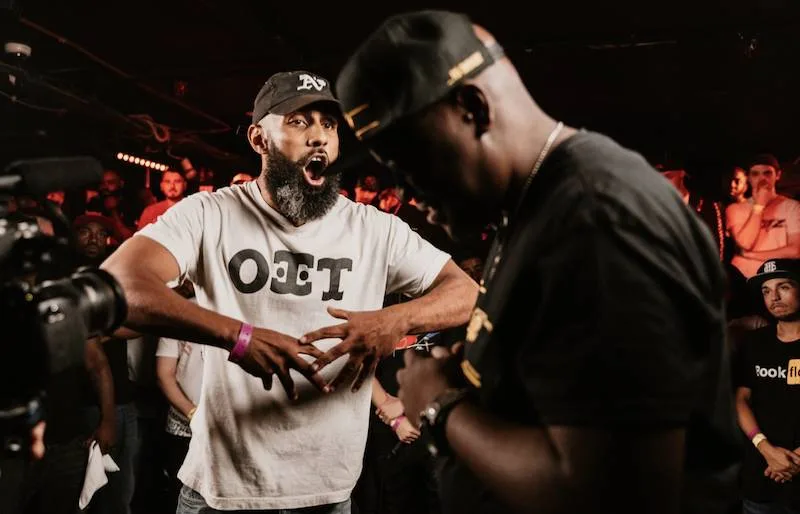
You can practice alone, with friends or in a cypher. A rap battle adds another challenge: responding to an opponent while maintaining your delivery. You do not need to start with battles to become a good freestyler.
How to rap on beat before you freestyle
Pick an instrumental with a clear drum pattern. A moderate tempo—around 80 to 95 beats per minute—is a useful starting point, but any speed at which you can speak comfortably is fine.
Listen for the kick and snare, then count one, two, three, four along with the music. Try speaking one short sentence over each musical bar. If you lose the beat, stop for a moment, find the count and start again. Staying in rhythm matters more than sounding impressive.
For private practice, you can use a suitable instrumental. Before publishing or monetizing a recording, check that you have permission to use the beat.
10 freestyle rap exercises you can try today
1. Count four bars without rapping
Time: 2 minutes. Play the beat and count four beats repeatedly. Tap your hand or foot if it helps. Next, replace the numbers with short spoken phrases, keeping each phrase inside the rhythm.
This exercise trains timing without the pressure of finding rhymes. If you cannot comfortably follow the beat while speaking, slow down before adding more words.
2. Speak first, rhyme second
Time: 2 minutes. Describe what you did this morning as if you were telling a friend. Speak in rhythm but do not worry about rhyming. Once you can sustain four bars, try ending every second line with a similar sound.
An understandable line delivered on beat is better practice than a complicated rhyme you cannot finish.
3. Build a small rhyme family
Time: 2 minutes. Choose a simple word such as night. Write or say related sounds: light, right, sight and flight. Now make two improvised lines that end with words from that family.
The goal is not to memorize a verse. It is to make several possible endings available while you invent the rest of the line. Change the word family whenever the exercise becomes easy.
4. Rap about objects in the room
Time: 2 minutes. Pick three objects you can see—a cup, a chair and a window, for example. Give yourself four bars to mention all three. Add one detail about each object rather than simply listing their names.
For a basic two-line example: “The rain hits the window while I wait for the train / I turn that little rhythm into words in my brain.” The rhyme is simple, but the second line grows naturally from the first.
This is a useful way to practice improvisation because the subject is right in front of you. Try it again with objects chosen by a friend so you cannot plan your ideas in advance.
5. Tell a story in four bars
Time: 3 minutes. Build a tiny story with a beginning, a problem and an ending. For instance: you miss a train, find another route and reach your destination. Use one or two bars for each moment.
Do not sacrifice the story just to force a rhyme. Clear connections between lines are what make listeners want to hear the next one.
6. Switch topics on command
Time: 2 minutes. Write five unrelated prompts on slips of paper: basketball, rain, school, space and coffee. Freestyle for four bars on the first topic, then draw another prompt and move directly to it.
At first, the transitions may sound awkward. That is part of the exercise. The skill you are training is moving forward without stopping to search for the perfect idea.
7. Complete the next line
Time: 2 minutes. Say a simple opening line such as, “I’m walking through the city tonight.” Give yourself one beat to begin the next line. Make the new line connect to the first through a detail, a rhyme or a change in perspective.
Repeat with different opening lines. This develops continuity: the ability to make a freestyle sound like connected thoughts rather than random rhyming words.
8. Add one internal rhyme
Time: 2 minutes. Once basic end rhymes feel natural, experiment with matching sounds inside a line as well as at the end. For example, you might pair quick steps with slick checks while keeping the sentence understandable.
Do not force several internal rhymes into every bar. Start with one. Rhythm and clarity are still more important than technical density.
9. Practice a response, not just a punchline
Time: 3 minutes. Ask a friend to give you a harmless statement: “You always arrive late.” Respond in four improvised bars using that idea. Focus on making your answer relevant before trying to make it funny or sharp.
In competitive freestyle, this kind of immediate response is often called a rebuttal. Training with simple prompts is an accessible way to begin building that skill without attacking another person.
10. Record a one-minute freestyle
Time: 3 minutes including playback. Set a timer, start your beat and keep rapping for one minute. Do not restart after a weak line. Listen back and ask three questions:
- Did I stay on beat?
- Could someone follow what I was saying?
- Did I recover after a mistake?
Choose just one thing to improve in the next recording. Repeated attempts give you a clearer picture of your progress than judging one performance as good or bad.
A 15-minute freestyle rap practice routine
You do not have to complete all ten drills every day. Rotate them using this simple routine:
| Time | Exercise | Goal |
|---|---|---|
| 3 minutes | Count and speak over a beat | Keep a steady rhythm |
| 3 minutes | Rhyme families | Find endings more quickly |
| 4 minutes | Objects or topic switches | Generate ideas in the moment |
| 3 minutes | Four-bar stories or responses | Connect your lines |
| 2 minutes | Record and listen back | Identify one improvement |
Try the routine several days a week, changing your beats and prompts. Increase the tempo only when you can stay comfortable at your current speed. You can also repeat a difficult drill instead of rushing toward more advanced techniques.
What can you learn from Spanish-language freestyle battles?
Latin American and Spanish freestyle competitions give you something valuable to study: how experienced MCs handle unexpected prompts, crowd reactions and direct responses while staying on the beat.
When you watch a battle, focus on one skill at a time. You might follow how a rapper links two ideas, notices something in the room or turns an opponent’s previous line into a rebuttal. Pause the video and try your own four-bar response in English.
Some punchlines rely on local slang, pronunciation or cultural references. A literal English translation may explain the words but miss the rhyme or double meaning. Context and subtitles can help you understand why the line worked; dubbing the original rhyme alone often cannot reproduce the effect.
Watching great performers is useful, but watching is not a substitute for practicing. Take one technique from a clip and try it on your own beat.
Five freestyle rap tips: beginner mistakes to avoid
- Rapping too fast. Speed makes it harder to control your breath, wording and timing. Start where you can speak clearly.
- Chasing a rhyme at any cost. A rhyme that does not make sense weakens the line. Express the idea first.
- Stopping after every mistake. Learning to recover is part of improvisation. Keep the beat moving.
- Repeating memorized bars as your only practice. Prepared lines can help you understand rhythm, but they do not replace the challenge of making new connections.
- Comparing yourself with professional battle MCs. You are watching performers with extensive experience. Measure progress against your own previous recordings.
Frequently asked questions
Can you freestyle rap without a beat?
Yes. Freestyling a cappella lets you focus on ideas and rhymes. Practicing with beats is still useful because rhythm is central to many rap performances.
Do all freestyle rappers improvise every line?
Not necessarily. The word freestyle has different uses across hip hop scenes, and some performances include prepared material. This guide focuses on spontaneous improvisation, often described as rapping off the top.
How long does it take to learn freestyle rap?
There is no universal timeline. You may become more comfortable staying on beat after several practice sessions, while developing original responses, stories and a distinctive flow takes sustained work. Short, regular sessions are a practical place to begin.
Is freestyle rap the same as battle rap?
No. Freestyle describes a way of performing rap; battle rap describes a competitive format. Some battles involve improvised verses, others include written material, and some combine both.
Final advice: keep the beat moving
The best first goal is not to create an unforgettable punchline. It is to improvise four understandable bars without losing the rhythm. Once that feels natural, aim for eight bars, one minute and eventually a full round.
Use the exercises in this guide, record your progress and pay attention to how real MCs adapt under pressure. Consistency will give you more to work with than waiting for inspiration to appear.